
The Research, Development and Adoption (R+D+A) dimension assesses countries' capacity to generate AI knowledge, turn it into innovation and promote its adoption, through three subdimensions: Research (centers, publications, researchers and gender perspective), Innovation and Development (AI companies, investment, R&D spending and technological output) and Adoption (economy and society).
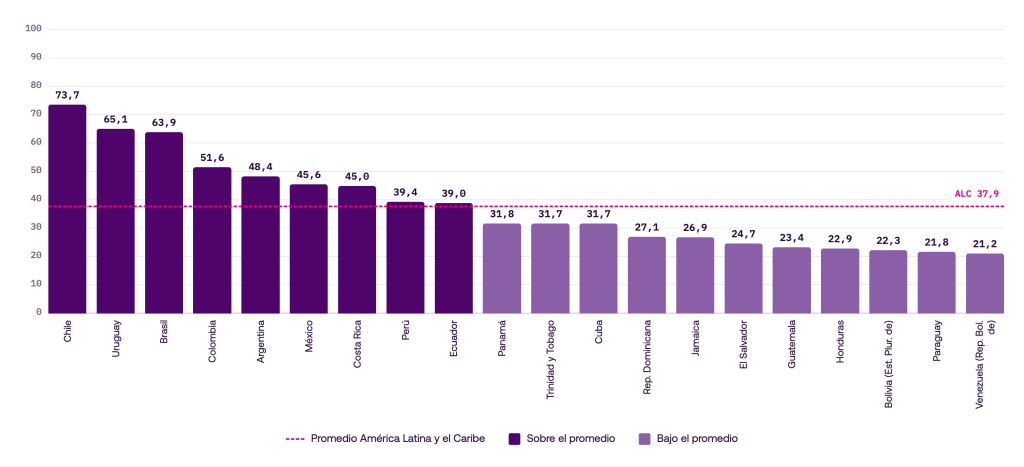
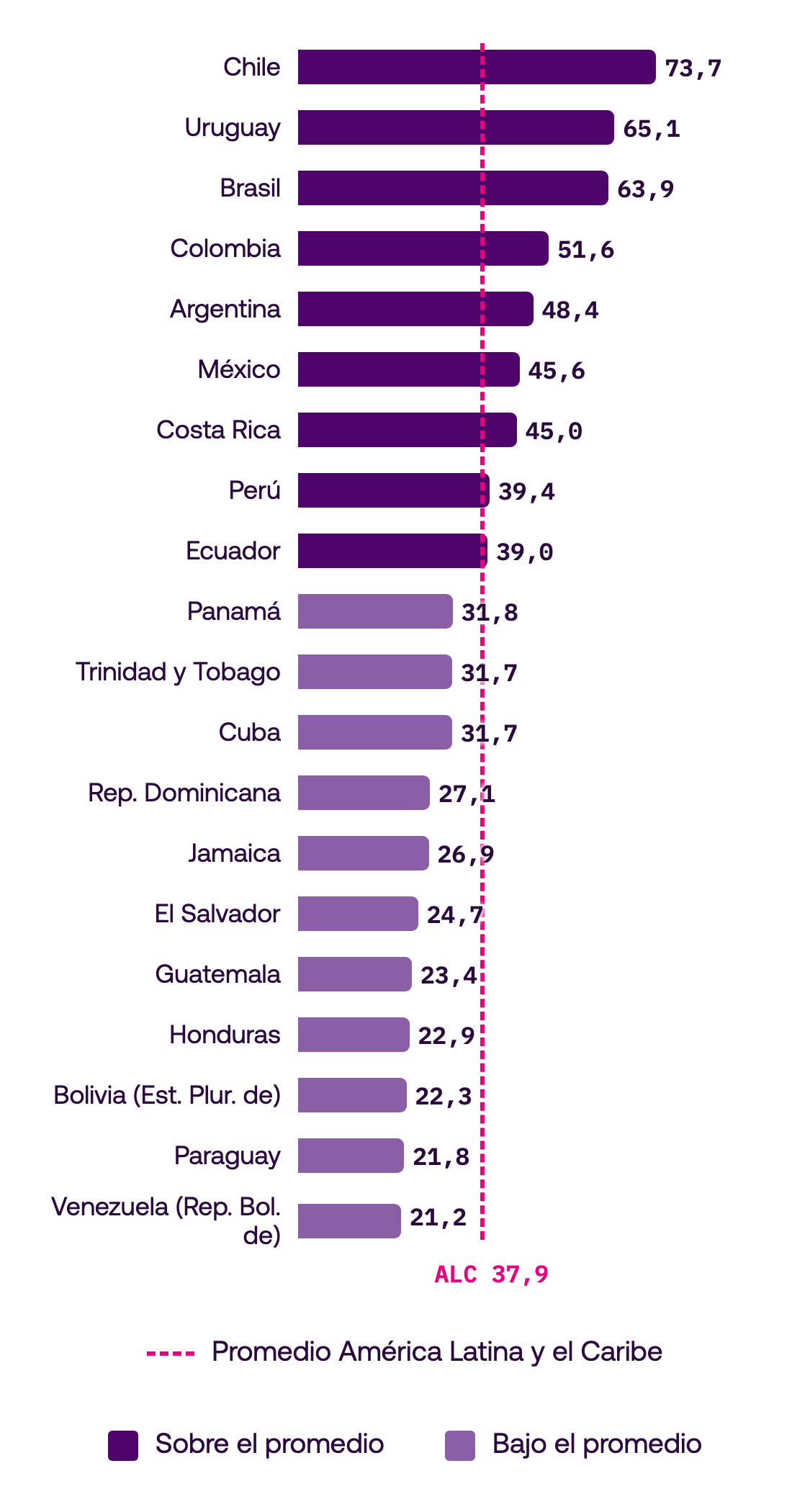
The Research, Development and Adoption dimension shows a significant reconfiguration of AI ecosystems in Latin America and the Caribbean. For the first time, three countries, Chile, Uruguay and Brazil, reach an advanced level of development, expanding the leading group compared with 2025, when only Chile was in this tier. At the same time, Colombia, Argentina, Mexico, Costa Rica, Peru and Ecuador strengthen their capabilities and improve their relative position in the mid-performance group. However, these advances coexist with a persistent reality: 55% of the countries assessed remain at early stages of R+D+A development, showing that, despite stronger regional leadership, consolidating the capacity to research, develop and adopt artificial intelligence remains a challenge for most Latin American ecosystems.
Scientific infrastructure for artificial intelligence continues to consolidate in Latin America and the Caribbean. In 2026, 65% of the region’s countries have at least one research center specialized in AI, seven percentage points more than in the previous edition. This progress reflects both the expansion of existing centers and the creation of new capabilities, with notable increases in Peru (+2), Brazil (+1), Guatemala (+1) and Costa Rica (+1) compared with 2025. Although the largest concentration of centers remains in a small group of countries, the expansion shows that AI research no longer depends on isolated initiatives and is moving toward growing institutionalization within national science and technology systems.
Scientific capacity in artificial intelligence continues to grow stronger in Latin America and the Caribbean. However, these advances remain concentrated in a small group of ecosystems such as Chile and Uruguay, with established scientific communities, sustained output and international presence. While a set of countries keeps strengthening its capabilities, half of the region remains at early stages of scientific development, showing that AI knowledge generation is still highly unequal. The results show that consolidating a scientific ecosystem requires much more than increasing the number of publications: it involves developing specialized centers, strengthening research careers and increasing impact and international collaboration.
The 2026 edition of ILIA includes, for the first time, indicators that measure gender gaps along the scientific career in AI. Although women account for 24.8% of researchers in the region, in 90% of countries their productivity is above the overall average (0.8 publications per woman researcher versus 0.59). Gaps persist in the continuity of scientific output and participation in the most prestigious international venues. Only 9.6% of women researchers maintain consistent scientific output, compared with 13.9% of all researchers, and just 30% of countries record women’s participation in A+ international conferences, compared with 45% that achieve participation overall. These results show that the challenge is no longer only to increase women’s participation, but also to strengthen their retention and visibility in the venues with the greatest scientific impact.
Scientific competitiveness in artificial intelligence is not measured only by the volume of publications. The results show that the countries with the highest scientific output are not necessarily those with the greatest presence at the most prestigious international conferences.
While Brazil, Mexico, Colombia and Chile account for the largest number of publications, 45% of the countries analyzed already participate in ICORE A+ conferences. In total, nine countries are present at these venues, two more than in ILIA 2025, while the average number of participating researchers rose from 7 to 11.6 per country. Chile, Argentina, Brazil and Uruguay stand out in particular for their per capita performance.
These results show the growing international integration of regional research: not only is the number of countries present in the most prestigious scientific circuits increasing, but so is the number of researchers taking part. The international reach of AI research thus depends both on the volume of scientific output and on the capacity to join the main global networks for generating and disseminating knowledge.
For the first time, ILIA includes a measurement of artificial intelligence adoption in the productive sector, revealing major gaps by company size. While 27.6% of large companies in the region have incorporated AI into their production processes, this share falls to 12.8% among medium-sized companies and reaches just 6.8% among small ones, which make up most of the Latin American business fabric. Although countries such as Uruguay, Chile and Brazil lead adoption in all three segments, the pattern holds across the region: the smaller the company, the lower the uptake of artificial intelligence. These results show that the main challenge for accelerating productive transformation is no longer just increasing AI adoption, but also broadening access among smaller companies, where the largest gaps persist.
Generative artificial intelligence is consolidating as the main gateway to AI use in Latin America and the Caribbean. On average, 16.1% of the population aged 15 to 64 actively uses generative AI tools. Costa Rica leads the region with an adoption rate of 25.1%, followed by Jamaica (22.2%), the Dominican Republic (22%), Uruguay (20.9%), Colombia (20.4%) and Panama (20.3%). At the same time, usage patterns are beginning to diversify: while Peru leads in intensity of use of AI and generative AI websites, Brazil, Chile and Uruguay stand out in access to advanced web AI tools, such as developer platforms, models, APIs and repositories. These results show that the region is advancing not only in the mass uptake of generative AI, but also in the adoption of more complex tools, reflecting a shift from general consumption toward more specialized uses of artificial intelligence.
Interest in agentic AI is growing rapidly among startups, driven by its potential to improve efficiency, reduce costs and transform processes. However, actual adoption continues to lag because of a gap between the available technological capabilities and the organizational maturity needed to implement them. Many organizations still lack adequate mechanisms for governance, oversight, risk assessment and value measurement, while a significant share of projects could fail due to a lack of clarity about their purpose and insufficient controls. In this context, the main challenge is no longer accessing the technology, but developing the institutional capabilities to implement, monitor and scale it safely and sustainably.
The region is strengthening its technological development capabilities through complementary strategies. While open-source software drives collaboration, collective learning and the creation of shared technological solutions, patenting activity reflects the capacity to turn that knowledge into inventions with potential for protection and technology transfer. The results show that there is no single path to building technological capabilities: Uruguay leads thanks to the strength of its developer ecosystem and the quality of its open-source output; Chile and Costa Rica stand out for their patenting performance; and Brazil combines a large developer community with the highest absolute number of AI patent families and inventors. This diversity of trajectories shows that technological development can be consolidated through different innovation models, as long as there is the capacity to turn knowledge into solutions with economic and technological impact.
Latin America and the Caribbean shows simultaneous progress in research, technological development and adoption of artificial intelligence. However, the results show that these capabilities do not always evolve in an integrated way. Rather than continuing to strengthen each dimension separately, the challenge for the region is to consolidate ecosystems capable of turning research into innovation and innovation into effective adoption, thereby accelerating the economic and social impact of artificial intelligence.
Measures each country’s capacity to generate new academic knowledge in the field of artificial intelligence, closely linked to the maturity of the local ecosystem in training and developing talent.
Covers AI progress within the local innovation and development ecosystem, such as the number of AI companies, private investment, the entrepreneurial environment and open-source development work.
Assesses progress in integrating AI into processes, operations, products or services within a country, including government, the private sector, civil society and citizens in general.


Measures the starting conditions for AI ecosystems to develop effectively: infrastructure, data and human talent.

Characterizes the state of the region's countries in AI governance: strategies, institutions, international cooperation, regulation and ethical, responsible and safe AI.