Comparable connectivity, a wide gap in compute
In connectivity, the gap between Latin America and the Caribbean and the extra-regional countries is smaller than in the rest of advanced digital infrastructure, and some countries in the region exceed extra-regional values on specific indicators. The difference widens considerably, however, when looking at the processing capacity available for developing and deploying AI systems. Even considering only the nine countries in the region with installed capacity, the extra-regional average is between 11 and 51 times higher, depending on the indicator; when all twenty countries in the region are considered, this ratio rises to between 24 and 113 times. This is compounded by a marked concentration of regional capacity: eleven countries have no infrastructure in any of the four areas analyzed, while Brazil holds 92% of GPU capacity and, together with Ecuador and Chile, concentrates 97.4%. The comparison thus shows two different scenarios: while Latin America and the Caribbean approaches extra-regional levels in connectivity, the differences in compute capacity are significantly larger and the infrastructure available in the region is concentrated in a small number of countries.
Certified data centers: a strength of Latin American and Caribbean infrastructure
The comparison of data infrastructure yields different results depending on the capacity observed. Extra-regional countries have, on average, about 57 times more secure internet servers than Latin America and the Caribbean. In certified data centers, however, Latin America and the Caribbean outperforms the comparison group in per capita terms: 0.92 centers per million inhabitants versus 0.73. The advantage is not limited to the best-placed countries, such as Costa Rica (4.46) and Panama (2.41): nineteen of the twenty countries in the region outperform Germany and sixteen outperform Portugal, so most of Latin America and the Caribbean ranks above much of the comparison group. The region thus has a significant base of certified infrastructure; the challenge is to leverage this capacity to strengthen other dimensions of advanced digital infrastructure and expand the availability of secure digital services.
Beyond products: strengthening the data ecosystem
Latin America and the Caribbean shows results close to the extra-regional countries in data products, that is, the statistical information that national systems manage to produce, but the gaps grow in the services that facilitate access and use and, above all, in the sources that underpin their production. In data products, the average difference is only 4.4 points on a 0–100 scale: seventeen countries reach at least the lowest value of the comparison group and Mexico even exceeds its maximum. In data services, the gap rises to 19.4 points and only Mexico reaches the group's lower threshold; in data sources, it reaches 24.5 points and only Mexico and Brazil reach it. The main regional challenge therefore seems to lie less in producing statistical products than in strengthening the sources that feed them and the services that allow them to be accessed and reused on a sustained basis.
Greater specialization, wider talent gap
The differences between Latin America and the Caribbean and the extra-regional countries widen as the level of AI talent specialization increases. Extra-regional countries show a concentration of AI engineering skills 4.1 times higher than Latin America and the Caribbean, a difference that reaches 4.7 times when looking specifically at women. The gap is considerably larger in advanced training: extra-regional countries have 20.9 times more doctoral programs per capita (0.723 vs. 0.035 programs per million inhabitants). This difference is explained less by the performance of the region's best-placed countries than by the absence of such programs in most of them: thirteen of the twenty Latin American and Caribbean countries have no program at all, while all five extra-regional countries have at least two. Chile is the only exception and, with 0.403 programs per million inhabitants, slightly exceeds Germany (0.395), the lowest value in the extra-regional group. The comparison thus shows that the talent gap deepens as specialization increases, peaking in advanced training, where the difference in doctoral programs is considerably larger than that observed in specialized AI skills.
Research: a difference in scale and continuity rather than productivity
In research, extra-regional countries have about 23 times more publications per capita, 18 times more active researchers and 30 times more consistent researchers than Latin America and the Caribbean. However, individual productivity is very similar: 0.63 publications per researcher versus 0.59 in Latin America and the Caribbean. An equivalent pattern is seen in software development communities, where the difference in the number of developers is much larger than the difference in contributions per person. The gap therefore seems to lie less in how much each participant produces and more in how many people take part and how long they manage to sustain that activity.
Adoption declines with company size
Business adoption of AI follows a common pattern in Latin America and the Caribbean and in the extra-regional countries: in both groups it declines as company size decreases. However, this pattern starts from considerably different adoption levels. In extra-regional countries, AI is used on average by 66% of large companies, 41% of medium-sized and 24% of small ones, compared with 28%, 13% and 7%, respectively, in Latin America and the Caribbean. Singapore is the most extreme case, with adoption reaching 100% in both large and medium-sized companies. However, the difference between Latin American and Caribbean and extra-regional countries does not depend solely on this case: excluding it, the other four countries maintain adoption close to double the Latin American and Caribbean average across all three company sizes. The comparison thus shows a shared trajectory by company size, but with systematically higher adoption levels among the extra-regional countries.
The gap grows with sophistication of use
The most advanced Latin American and Caribbean countries come close to several extra-regional countries in digital government and in general use of AI on the web. For example, Peru reaches an intensity of general use comparable to Spain, Estonia and Portugal, and higher than Germany. The difference grows when more advanced uses are considered: all five extra-regional countries exceed the Latin American and Caribbean maximum, held by Brazil, and their average is three times that of Latin America and the Caribbean. The contrast shows that relatively widespread diffusion of AI tools is not necessarily accompanied by an equivalent intensity in more advanced uses.
Different capabilities, multiple AI development trajectories
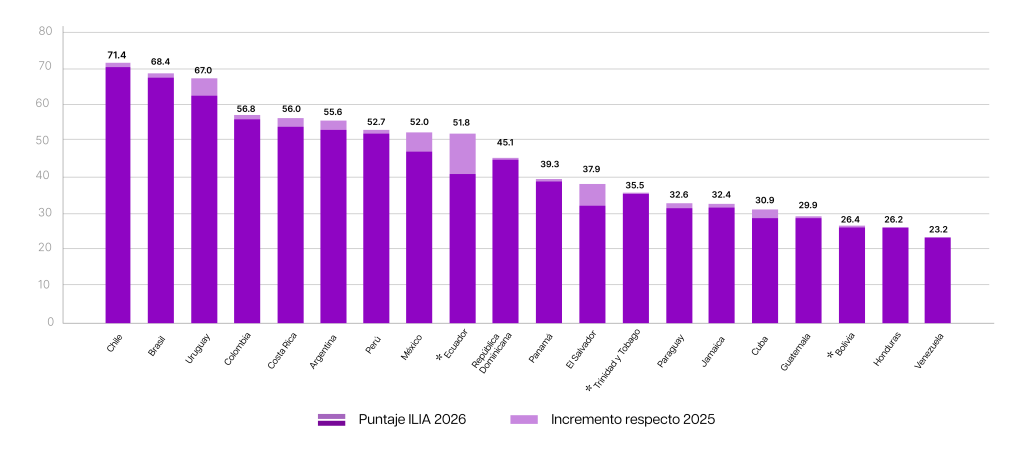
Germany has a research-and-development-intensive profile, with high R&D spending, large scientific and technical communities and high patenting activity. Singapore combines dense scientific and technical communities with high levels of investment, patenting and adoption, and achieves particularly strong results in developers and patents with lower relative R&D spending than Germany. Estonia stands out for its density of companies, investment and digital capabilities, although these strengths do not translate into an equivalent level of patenting. Spain and Portugal show more intermediate profiles. Latin America and the Caribbean also has distinct strengths: Brazil stands out in R&D spending and achieves results comparable to the extra-regional countries in digital government; Chile and Brazil are the closest regional cases in private investment; and Uruguay excels in developer density and business adoption.
Funding, the main difference in implementing AI strategies
All five extra-regional countries show full implementation of their AI strategy: 100% have evaluation mechanisms, a roadmap and an allocated budget, without exception. Among the 12 Latin American and Caribbean countries that already have an officially adopted AI strategy, progress is substantial but uneven: 11 (92%) have some mechanism to assess compliance and 10 (83%) have some kind of roadmap, although only 5 have a fully specified plan. The gap is evident in the budget: all five comparison countries specify an amount allocated to their AI strategy, while in the region only Brazil and Colombia specify an allocated amount, and Chile mentions an allocation without stating the amount. The remaining 9 countries in the region with an adopted strategy (75%) report no budget at all. The comparison thus shows that the main difference lies not in the existence of instruments to guide and monitor strategies, but in the explicit budgetary backing that accompanies their implementation.
Gender perspective: Latin America and the Caribbean stands out in AI strategies
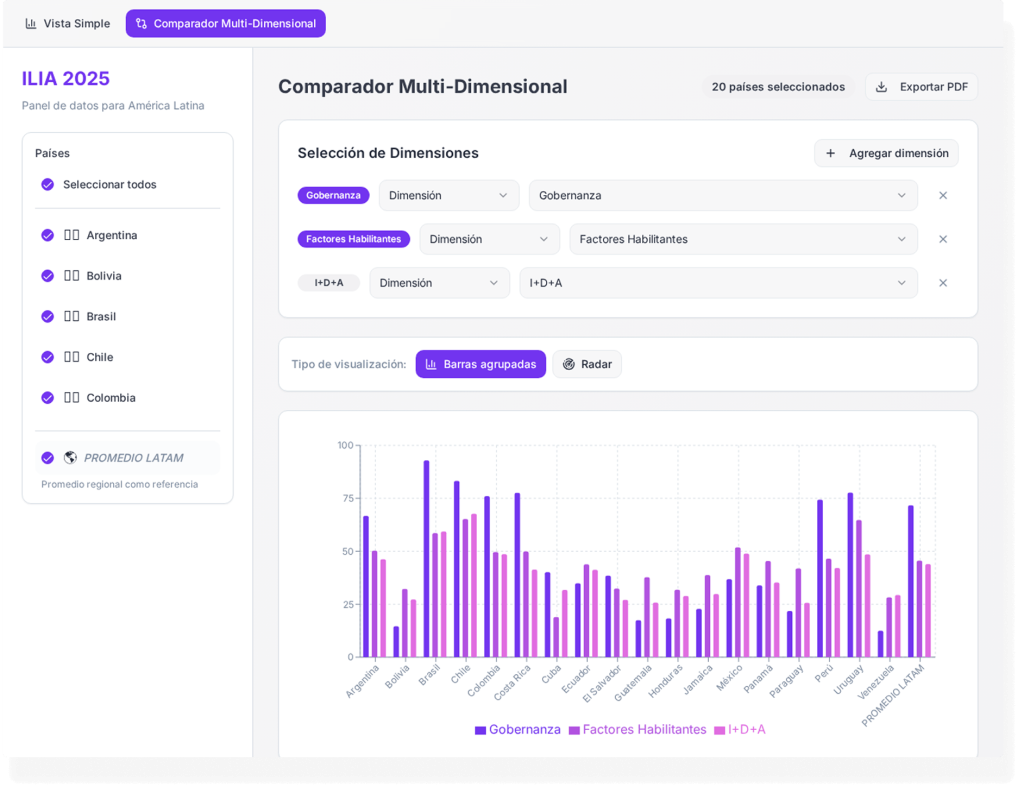
Among the five extra-regional countries with an AI strategy, none includes a gender perspective among its topics: all five receive the minimum score (0) on this subindicator, without exception. Among the countries with a strategy in Latin America and the Caribbean, the picture is the opposite: seven countries (Chile, Colombia, Costa Rica, Cuba, Ecuador, the Dominican Republic and Uruguay) explicitly include this approach with an associated commitment or task (maximum score), and Argentina and Peru mention it without a commitment (50). Together with the share of renewable energy, it is one of only two subindicators in the entire Governance dimension where the overall average of the extra-regional countries falls below the regional average.
Renewable energy, an asset for AI development in Latin America and the Caribbean
Latin America and the Caribbean has a share of renewable energy comparable to, and in some cases higher than, that of the extra-regional countries. This is especially clear when looking at national trajectories: Paraguay, Costa Rica, Uruguay, Venezuela, Brazil and Colombia have a higher share of clean energy than Portugal, the extra-regional country with the largest share of renewable sources in the group analyzed. In contrast, Singapore has an energy mix with a considerably lower share of these sources. This energy mix is an asset for several Latin American and Caribbean countries in the face of the growing energy demand associated with AI development.