
The Enabling Factors dimension measures progress in the elements that are a necessary condition for AI ecosystems to develop effectively, such as digital infrastructure, data availability and use, and human talent.
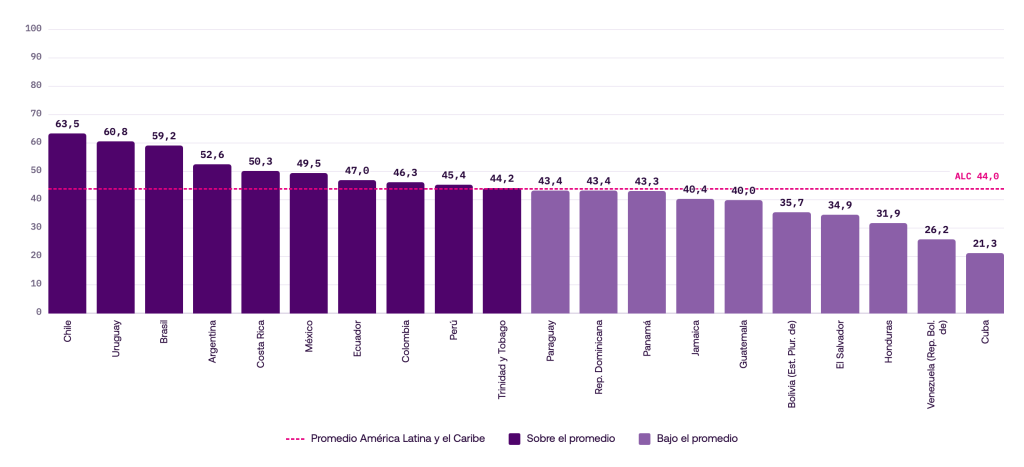
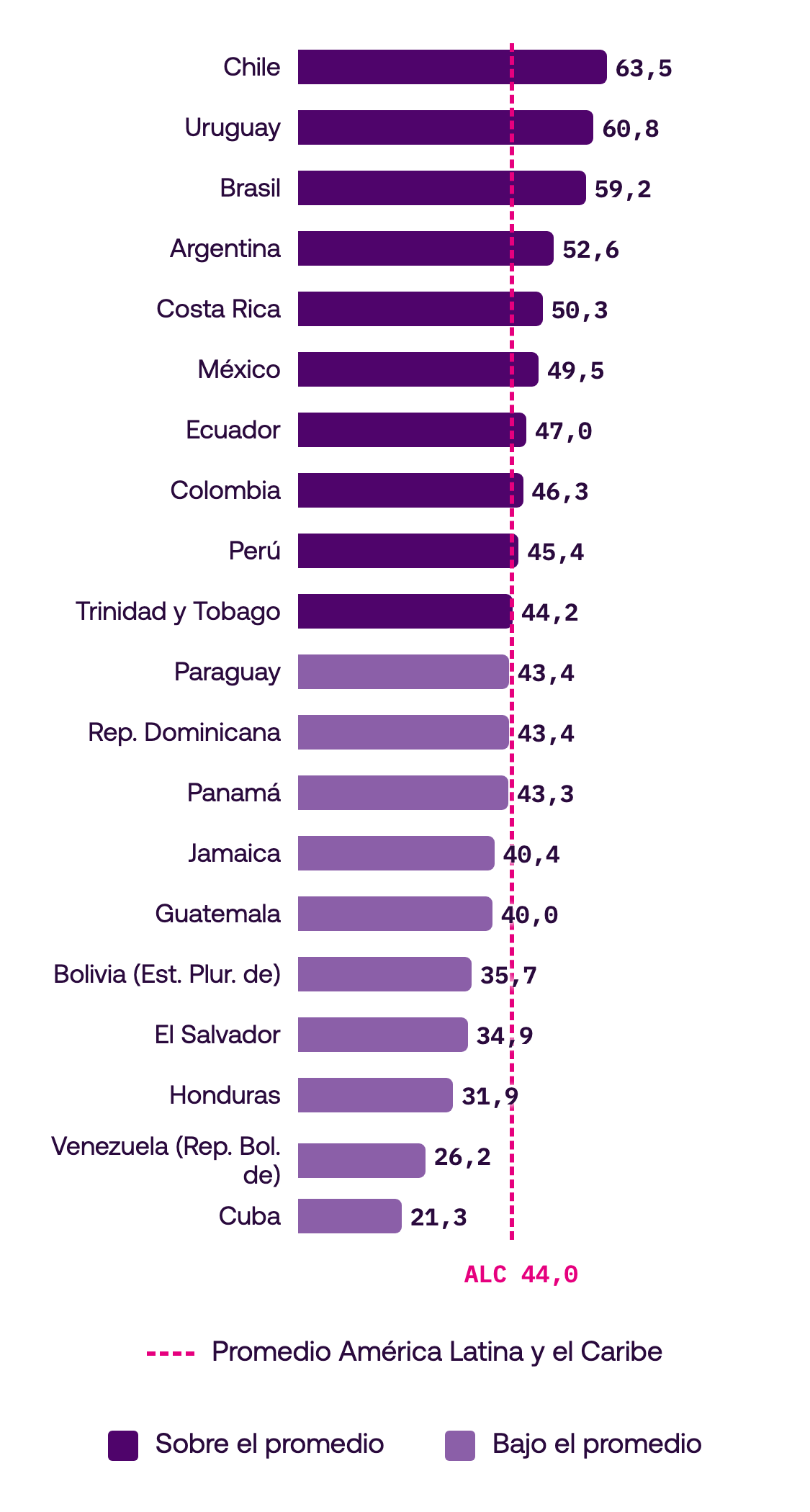
Regional leadership in Enabling Factors varies depending on the capabilities analyzed and shows different poles of development. Chile and Uruguay show the most consistent performance across the dimension as a whole, while Brazil stands out especially for its Infrastructure capabilities, with particularly marked leadership in Compute.
Ecuador also stands out in this last area, followed by Argentina. In Data, the group of countries with advanced ecosystems is considerably larger, led by Chile, Mexico and Brazil, with strong performances also from Colombia, Uruguay, Argentina and Ecuador.
The picture changes when looking at Human Talent: only Chile, Uruguay and Trinidad and Tobago reach a moderate level. The results show that the main gap in enabling factors lies not only in having infrastructure and data, but in having the human capabilities needed to take advantage of them.
Connectivity continues to expand in Latin America and the Caribbean. On average, 95% of the population has mobile network coverage, 80% uses the internet and 68.4% of households have access, all indicators that show progress compared with the previous edition.
However, the expansion of access coexists with major differences in the quality and sophistication of networks. 5G coverage reaches a regional average of only 28% and varies widely across countries, while speeds also show uneven performance: mobile download speed averages 58.3 Mbps, compared with 139.6 Mbps for fixed broadband.
The region is moving toward increasingly widespread connectivity, but significant differences persist in the technological conditions under which people connect and access advanced digital services.
Fixed broadband affordability shows a significant improvement in Latin America and the Caribbean, but it remains a barrier for much of the region.
The cost of the cheapest fixed broadband plan represents, on average, 4.7% of monthly gross national income per capita, a considerable reduction from the 8.5% recorded in ILIA 2025, driven mainly by progress in the countries that ranked lowest in the previous edition.
However, 85% of countries remain above the 2% reference threshold. Only Mexico (1.7%), Chile (1.8%) and the Dominican Republic (1.9%) are below this level, with the Dominican Republic joining this group since the previous edition. The region has made significant progress in reducing the relative cost of fixed connectivity, but affordable access remains a challenge for the vast majority of countries.
Compute capacity for artificial intelligence is highly concentrated in a small group of Latin American and Caribbean countries. Considering clusters with at least eight GPUs, only 45% of the countries analyzed have infrastructure of this kind. Together, these clusters bring together 17,330 GPUs, of which Brazil holds 87.7%, followed at a considerable distance by Ecuador (4.2%), Argentina (2.3%), Chile (2.1%) and Mexico (2.0%). The remaining 1.7% is spread across Colombia, Uruguay, Panama and Costa Rica.
The concentration is even greater in terms of compute capacity. The clusters analyzed reach a combined 12.7 million FP16 TFLOPS, of which Brazil holds 92%. It is followed by Ecuador (3.2%), Chile (2.2%) and Argentina (1.1%), while the remaining 1.5% is spread across Colombia, Uruguay, Mexico, Panama and Costa Rica.
The availability of data for artificial intelligence development depends not only on its existence or accessibility, but also on the legal conditions that allow it to be accessed and used. In Latin America and the Caribbean, the lack of legal certainty for text and data mining (TDM) limits corpus building and model training, even when usable data exist.
This barrier is especially relevant for research and for the development of sovereign AI systems, where obtaining case-by-case authorizations increases costs, limits coverage and can introduce biases into datasets.
The regional data gap therefore has a legal dimension: advancing mechanisms that provide greater certainty for data use will help turn existing data into a resource that is effectively available for developing AI that serves people.
The inclusion of artificial intelligence content in school education is accelerating in Latin America and the Caribbean. In 2024, only two countries included AI content in their secondary education curricula or guidelines; in 2025 the figure rose to six and, in 2026, it reaches eleven of the twenty countries analyzed.
This year Panama, Mexico, Colombia, El Salvador and Argentina join Brazil, Chile, Costa Rica, Ecuador, the Dominican Republic and Uruguay. Thus, for the first time, more than half of the countries analyzed include AI content in their curricula, consolidating a trend toward developing skills related to these technologies from the early stages of education.
However, progress is still uneven: the remaining nine countries include content related to information and communication technologies (ICT), but do not yet directly address artificial intelligence.
The specialized skills needed to develop and adopt artificial intelligence remain scarce in the Latin American and Caribbean labor market.
The average concentration of AI skills reaches just 0.27% of the working population registered on LinkedIn. This gap also extends to the complementary capabilities needed to sustain AI ecosystems: cybersecurity skills reach an average concentration of 0.24%, while talent with data center skills accounts for 0.6%.
In this last area, there is also a marked concentration across countries: Brazil reaches 5.2%, well above Mexico (1.1%) and Argentina (0.9%), the other two countries above the regional average. The talent challenge is not limited to developing skills directly related to AI; it also includes the complementary professional capabilities needed to develop, deploy and sustain these technologies.
The new indicators make it possible to track differences between men and women from basic to professional capabilities. Internet use among women reaches a regional average of 73.7%, compared with 80% for the general population; the performance of girls and adolescents in mathematics and science is five points below the overall average; and English skills among women are eight points lower. The difference widens in professional capabilities directly related to AI: the average concentration of AI skills falls from 0.27% for all workers to 0.17% among women.
Advanced AI talent training continues to expand in Latin America and the Caribbean, at both master’s and doctoral levels in accredited universities. In 2026, all twenty countries analyzed have AI master’s programs, while thirteen have doctoral programs, compared with eight in the previous edition.
At the master’s level, Honduras and Cuba join the group of countries offering programs, along with Trinidad and Tobago, which enters ILIA for the first time. At the doctoral level, Ecuador, Bolivia, Costa Rica and Venezuela join, along with Trinidad and Tobago.
However, the scale of the offering varies considerably: the largest numbers of master’s programs are in Mexico (63), Brazil (41) and Colombia (31), while the leaders in doctoral programs are Brazil (25), Mexico (21) and Chile (14).
Covers the technological support available in a country as a necessary condition for AI development, such as the number of high-performance computers, high-speed networks and devices that enable a good connection.
Measures data availability, capability and governance based on countries’ performance in the Global Data Barometer 2025.
Covers the variables that influence the development of AI skills among the population and the workforce.


Assesses countries' capacity to generate AI knowledge, turn it into innovation and technological development, and bring it to the economy and society.

Characterizes the state of the region's countries in AI governance: strategies, institutions, international cooperation, regulation and ethical, responsible and safe AI.