
The Governance dimension characterizes the state of the region's countries in developing frameworks that foster responsible AI adoption, through four subdimensions: Vision and Institutional Framework, International Engagement, Regulation, and Ethical, Responsible and Safe AI.
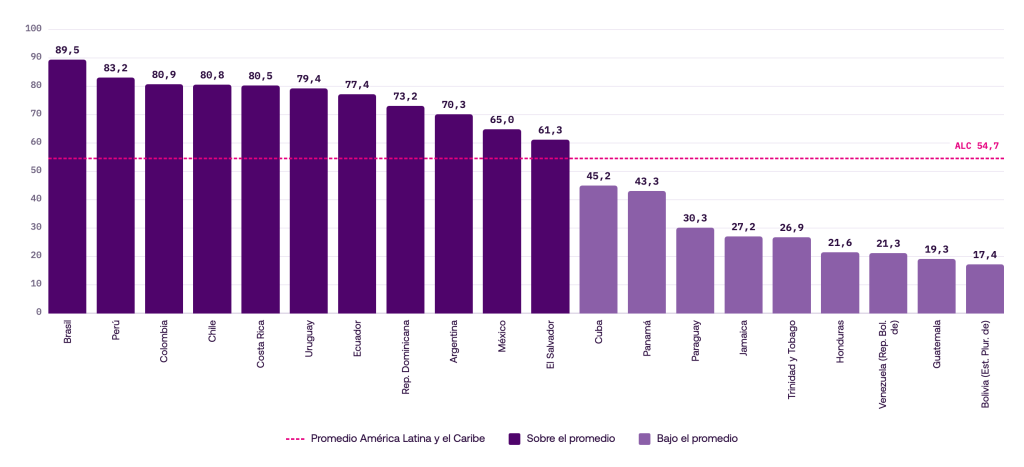
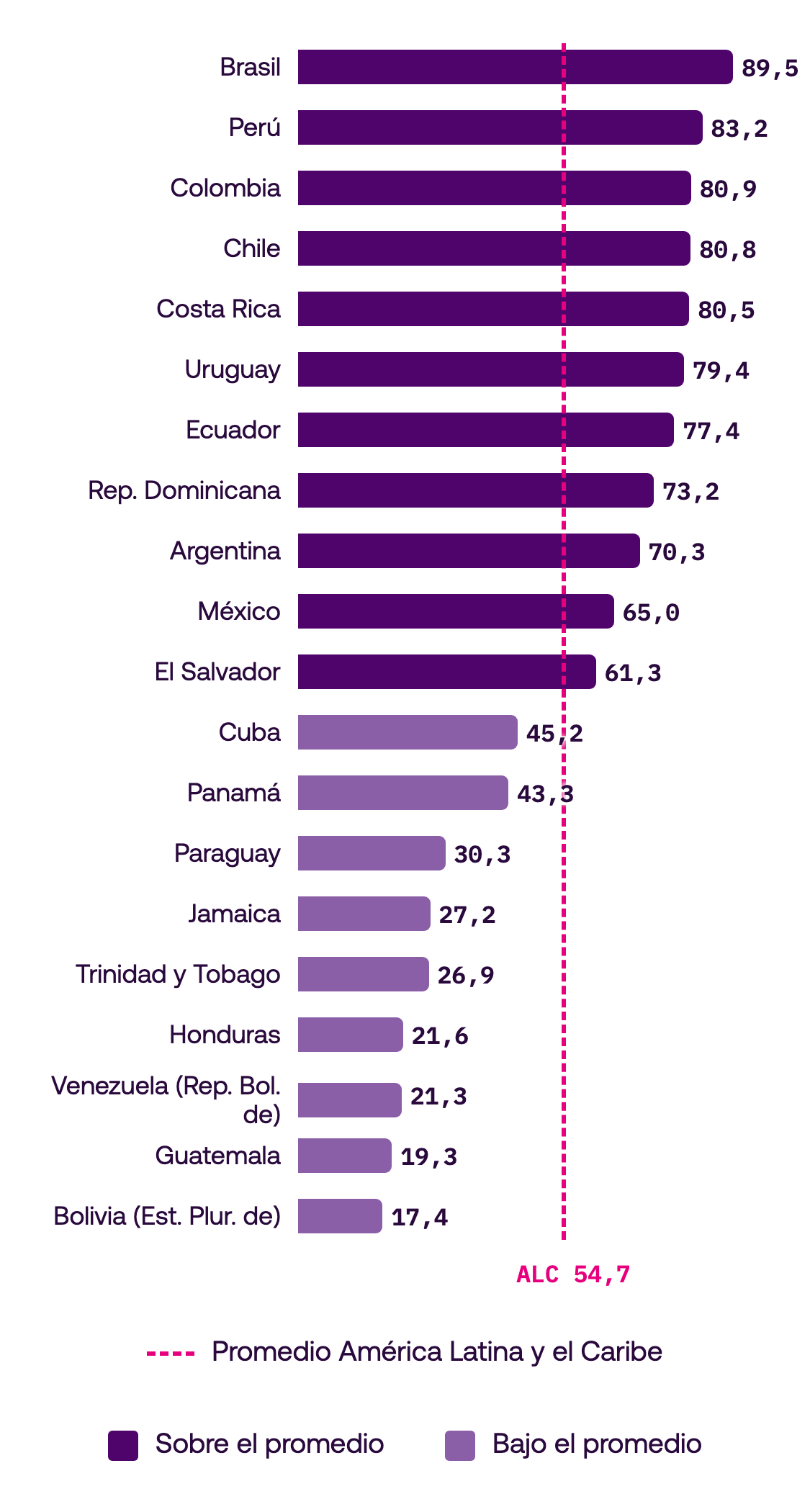
Multi-stakeholder participation has been consolidated mainly in the drafting of national AI strategies. 75% of countries with a strategy in force used a multi-stakeholder methodology, and the same share included some mechanism for citizen participation. However, this participation declines during execution: only half of the countries with a strategy in force formally involve actors outside government in its implementation. This gap can limit the incorporation of diverse knowledge and capabilities, make it harder to identify obstacles early and weaken the legitimacy of policies.
75% of countries (15 of 20) have an institution formally mandated to lead national AI initiatives, a significant increase from the 52.6% recorded in the previous edition. In addition, all countries with a national strategy have established inter-institutional coordination mechanisms for its implementation, strengthening coordination among the various state bodies. These advances show the region’s growing institutional maturity, where the creation of responsible entities and coordination mechanisms is becoming established as a necessary condition for turning national strategies into effective and sustainable public policies.
85% of countries have a national AI strategy in force or are developing one, a significant advance from the previous edition, when this figure was 63%. In a single year, Ecuador, El Salvador and Mexico went from having no strategy and none in preparation to having a national instrument in force, while Guatemala formally began drafting its own. However, a small group of countries still has no national strategy in force and none in preparation, which could hinder public policy coordination, investment mobilization and capacity building.
Of the twelve countries with a strategy in force, eleven include some evaluation mechanism. Within this group, two thirds already define specific indicators and/or an institution responsible for monitoring. This share is more than double that of the previous ILIA edition, reflecting a shift from strategies focused on setting objectives toward instruments with greater monitoring capabilities. These evaluation mechanisms are a sign of the strategies’ institutional maturity, as they make it possible to measure progress, correct deviations and ensure the continuity of public policies over time.
Only 25% of countries with a strategy mention the allocation of budgetary resources to implement the measures it contains. This share falls to 16.7% when considering only cases where the budget is explicitly defined in the instrument. Only Brazil and Colombia are in this situation. This raises a key question: are countries funding the development of their AI policies through other budgetary structures, or will the lack of allocated resources jeopardize their effective implementation?
National AI strategies show marked thematic convergence across the topics analyzed. Capacity building is included through commitments or tasks in all documents, while ethics and governance, infrastructure, data, digital government, industry, and research and development are included at that level of depth in eleven of the twelve strategies in force, with the exception not always being the same strategy. By contrast, regional and international cooperation, gender perspective and sustainability have a smaller presence and, in some cases, are limited to mentions without concrete implementation mechanisms. It is worth examining whether this thematic completeness matches the needs each country should strategically address.
The region’s countries are widely engaged with international initiatives and bodies related to artificial intelligence: 90% participate in at least one of the five forums considered, including the Santiago Declaration, the Global Partnership on Artificial Intelligence and the OECD AI Principles. However, active participation in the spaces where international technical standards are drafted remains limited. Although 50% of countries belong to the ISO subcommittee on artificial intelligence and 70% take part in the one on information security, cybersecurity and privacy protection, only 25% and 35%, respectively, do so as participating members. This limited active participation restricts the region’s formal opportunities to influence the technical standards that will guide the future development and governance of AI.
The strategies published in 2026 retain several of the gaps identified in previous years. Although they have a relatively homogeneous structure and all address infrastructure and technology, capacity building, and research and development, none specifies the budgetary resources needed to carry them out, only one includes a detailed roadmap and three provide for specific monitoring mechanisms. Thus, the publication of new strategies has not necessarily translated into more complete instruments that provide better conditions for implementation.
The region’s countries are widely engaged with international initiatives and bodies related to artificial intelligence: 90% participate in at least one of the five forums considered, including the Santiago Declaration, the Global Partnership on Artificial Intelligence and the OECD AI Principles. However, active participation in the spaces where international technical standards are drafted remains limited. Although 50% of countries belong to the ISO subcommittee on artificial intelligence and 70% take part in the one on information security, cybersecurity and privacy protection, only 25% and 35%, respectively, do so as participating members. This limited active participation restricts the region’s formal opportunities to influence the technical standards that will guide the future development and governance of AI.
The new edition of the Global Index on Responsible AI (GIRAI) shows that the region still has significant gaps in the conditions for responsible artificial intelligence, although results vary by area. In data protection and privacy, the region continues to lag behind Europe and North America, while in AI safety and security, Central and South America reach a comparatively more favorable position. At the country level, Mexico, Peru and Chile stand out in data protection and privacy, while Brazil, El Salvador and Chile lead in safety and security. Likewise, the progress made by Ecuador, Peru, Paraguay, El Salvador, Uruguay and Colombia since the previous edition shows a favorable, though still uneven, evolution of national capabilities for responsible and safe AI governance.
Conducts a thorough review of the AI strategies and policies of each country in the region, from their content to their monitoring mechanisms.
Assesses countries’ participation in forums relevant to establishing global governance and the influence they achieve in those spaces.
Considers the bills, laws and regulations in force in each country, along with cybersecurity and personal data protection regulation. It also assesses ethical and sustainability aspects of AI development.
Considers the bills, laws and regulations in force in each country, along with cybersecurity and personal data protection regulation. It also assesses ethical and sustainability aspects of AI development.