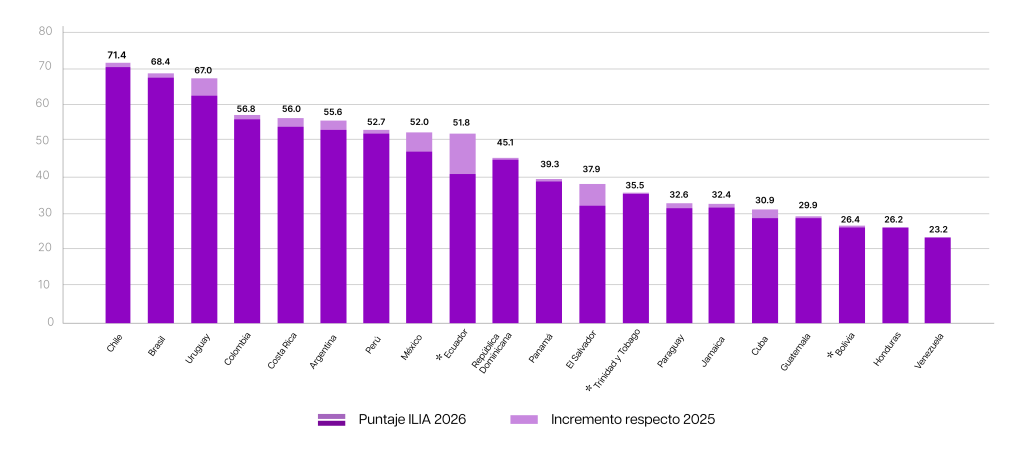
The Latin American Artificial Intelligence Index (ILIA) is an instrument that measures the level of readiness, development and governance of Artificial Intelligence in 20 countries of Latin America and the Caribbean.
It is led by Chile’s National Center for Artificial Intelligence (CENIA) and the Economic Commission for Latin America and the Caribbean (ECLAC), with the support of other public and private organizations.
For this Index, sovereignty in artificial intelligence does not necessarily mean achieving technological self-sufficiency, but rather having countries’ effective capacity to make decisions and preserve alternatives in an environment of high technological interdependence.
For Latin America and the Caribbean, this means combining the strengthening of their own capabilities with external relationships that preserve alternatives and broaden countries’ room for manoeuvre and their capacity for agency.
In this scenario, regional cooperation takes on strategic value. Having spaces that institutionally foster the sharing of infrastructure, knowledge, talent and technological capabilities can help address challenges that are difficult to solve individually while strengthening the region’s position of influence vis-à-vis global players.
From this perspective, sovereignty is not measured solely by the degree of technological independence, but by the capacity for regional agency: acting within interdependence.
For ILIA, this means complementing the measurement of existing capabilities with information on the technological relationships that determine how much effective room countries have to forge alliances, preserve and promote local alternatives, and uphold their decisions.
Brazil concentrates almost all of the artificial intelligence compute capacity identified in Latin America and the Caribbean, with 87.7% of GPUs and 92% of regional processing capacity, while the rest of the infrastructure is spread across a small number of countries.
This concentration is compounded by a wide gap with extra-regional countries (Portugal, Spain, Estonia, Germany and Singapore), which on average have about 29 times more GPUs per million inhabitants than LAC (244.7 vs. 8.5).
In this context, it is urgent to explore new schemes of shared infrastructure or regional compute, which could be a viable alternative to narrow this gap and take advantage of economies of scale.
More and more countries in Latin America and the Caribbean have centers specifically dedicated to artificial intelligence research. In 2026, 65% of the countries assessed have at least one, 7 percentage points more than in the previous edition, an expansion showing that AI research is building more stable capabilities and no longer depends exclusively on isolated researchers or initiatives.
Although these capabilities remain concentrated in a small group of countries, such as Argentina, Brazil, Mexico and Peru, the trend points to an increasingly solid scientific base in the region.
Artificial intelligence is making strong inroads into education in Latin America and the Caribbean, from school education to the most specialized levels. For the first time, more than half of the countries analyzed include AI content in their school curricula: while only two did so in 2024, the figure reaches eleven in 2026.
Progress is also seen in specialized training: all 20 countries included in ILIA now offer AI-related master’s programs. In this edition, Honduras and Cuba join those already offering them, while Trinidad and Tobago, included in ILIA for the first time, also has AI master’s programs. At the doctoral level, coverage grew from eight to 14 countries compared with the previous measurement.
These capabilities are complemented by highly qualified professionals trained abroad, who then contribute to the development of local AI ecosystems. Taken together, the data show that AI education is no longer concentrated at the most specialized levels and is beginning to extend across the entire educational pathway.
The availability of data for artificial intelligence development depends not only on its existence or accessibility, but also on the legal conditions that allow it to be accessed and used. In Latin America and the Caribbean, the lack of legal certainty for text and data mining (TDM) limits corpus building and model training, even when usable data exist.
This barrier is especially relevant for research and for the development of sovereign AI systems, where obtaining case-by-case authorizations increases costs, limits coverage and can introduce biases into datasets.
The regional data gap therefore has a legal dimension: advancing mechanisms that provide greater certainty for data use will help turn existing data into a resource that is effectively available for developing AI that serves people.
Renewable energy is one of the assets on which Latin America and the Caribbean can build its artificial intelligence development. Paraguay, Costa Rica, Uruguay, Venezuela, Brazil and Colombia have a share of clean sources that exceeds even Portugal, the extra-regional country with the highest share of renewable energy among those analyzed.
This strength is combined with a favorable position in data infrastructure: the region outperforms the comparison group in certified data centers per capita, with an average of 0.92 centers per million inhabitants versus 0.73.
Linking these strengths with the development of new digital and compute capabilities opens an opportunity to move toward a safer and more sustainable AI infrastructure that is integrated into the global technology value chain.
The results show that significant gender differences persist in training and capacity building related to artificial intelligence in Latin America and the Caribbean. The differences range from internet use and performance in mathematics, science and English to the development of professional AI skills.
The gap continues in research. Women account for only 24.8% of AI researchers in the region and show less continuity in their careers, as well as a lower presence in the highest-impact scientific venues.
But the data reveal a contrast: although there are far fewer of them, the women researchers who remain in the system show high scientific productivity. In 90% of the countries analyzed, their research productivity exceeds the overall average, with 0.8 publications per woman researcher versus 0.59 for researchers as a whole.
The same phenomenon is seen in the extra-regional countries used as a reference, where women account for 27.4% of active AI researchers and also exceed the overall average of scientific productivity.
The result speaks for itself: women still face barriers to entering and staying in AI research, but those who succeed show outstanding scientific performance.
The trend is seen both within Latin America and the Caribbean and in the extra-regional countries, but it is more pronounced in LAC. While 27.6% of large companies use AI, only 12.8% of medium-sized and 6.8% of small companies have adopted this technology. In the comparison countries, the figures reach 66%, 41% and 24%, respectively.
The region thus faces a double gap: it adopts less AI across all company sizes, and the gap widens among the smallest firms, which also make up most of its productive fabric.
Even so, size need not be a barrier. Singapore reaches 100% adoption among large and medium-sized companies. For Latin America and the Caribbean, the challenge is twofold: increasing adoption and preventing smaller companies from being left behind.
AI agents, systems capable of performing tasks and making certain decisions with greater autonomy, are attracting growing interest among startups for their potential to improve efficiency, reduce costs and transform processes. However, enthusiasm is moving faster than actual adoption.
The main barrier does not seem to lie only in the technology, but in organizations’ capacity to integrate it: defining what to use these systems for, how to supervise them, what risks they are willing to take and how to measure the value they generate.
About 80% of companies worldwide say they lack the maturity to adopt AI agents, and it is estimated that 40% of agentic AI projects will be cancelled by 2027 due to lack of clarity or weak control systems.
The challenge, therefore, is not simply to incorporate AI agents, but to prepare organizations to use them, supervise them and scale them safely and sustainably.
The region is making progress in creating strategies and institutions to steer the development of artificial intelligence: 85% of the countries analyzed have a national AI strategy in force or in preparation, compared with 63% in the previous edition, and 75% have an institution formally in charge of leading it, compared with 52.6%. This is a clear sign of maturity in AI governance.
Planning is also becoming more complete. Of the 12 countries that have already adopted a strategy, 11 have mechanisms to assess progress and 10 have a roadmap.
Even so, the main challenge appears when moving from planning to implementation: only Brazil and Colombia specify a budget to carry out their strategies, in stark contrast with the five extra-regional countries analyzed, all of which have an explicitly allocated budget.
It follows that the region has made progress in defining what it wants to do with AI and who should lead that process, while securing the resources to put those plans into practice remains a clear challenge.
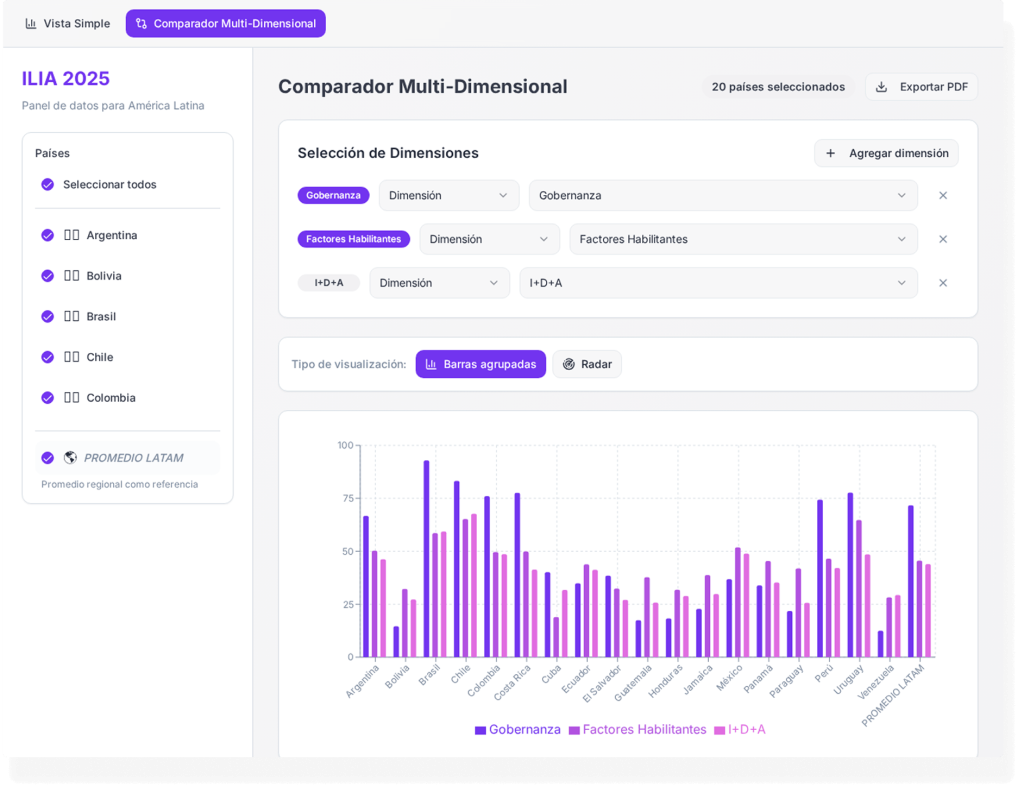
Enabling Factors measures the baseline conditions for AI ecosystems to develop, through three subdimensions: Infrastructure (connectivity, compute, devices and digital services), Data (availability, governance and capabilities to manage it) and Human Talent (development of AI skills throughout life).
The Research, Development and Adoption (R+D+A) dimension assesses countries' capacity to generate AI knowledge, turn it into innovation and promote its adoption, through three subdimensions: Research (centers, publications, researchers and gender perspective), Innovation and Development (AI companies, investment, R&D spending and technological output) and Adoption.
The Governance dimension characterizes the state of the region's countries in developing frameworks that foster responsible AI adoption, identifying progress and notable experiences in strategy, stakeholder participation, institutional capacities, international engagement and regulation.
The 2026 edition of ILIA adds a new chapter comparing the region with extra-regional countries: Germany, Spain, Estonia, Portugal and Singapore. This selection brings together benchmarks that differ in trajectory, scale and population, and shows in which areas the region is getting closer to them and where the largest gaps persist, without proposing a single model for AI development.
New ILIA 2026 chapter
Germany · Spain · Estonia · Portugal · Singapore
This fourth edition of the index includes a new chapter that broadens ILIA's scope and places the capabilities of Latin America and the Caribbean alongside five extra-regional countries: Germany, Spain, Estonia, Portugal and Singapore. The aim is to identify in which areas the region is approaching these benchmarks, where the main gaps are concentrated, and which combinations of capabilities different countries have pursued to advance in the development and governance of artificial intelligence.
For this exercise, a selection of subindicators from the three dimensions was analyzed. The selection reflects a prioritization of subindicators suited to an extra-regional comparison and the availability of comparable information for both groups.
Comparable connectivity, a wide gap in compute
In connectivity, the gap between Latin America and the Caribbean and the extra-regional countries is smaller than in the rest of advanced digital infrastructure, and some countries in the region exceed extra-regional values on specific indicators. The difference widens considerably, however, when looking at the processing capacity available for developing and deploying AI systems. Even considering only the nine countries in the region with installed capacity, the extra-regional average is between 11 and 51 times higher, depending on the indicator; when all twenty countries in the region are considered, this ratio rises to between 24 and 113 times. This is compounded by a marked concentration of regional capacity: eleven countries have no infrastructure in any of the four areas analyzed, while Brazil holds 92% of GPU capacity and, together with Ecuador and Chile, concentrates 97.4%. The comparison thus shows two different scenarios: while Latin America and the Caribbean approaches extra-regional levels in connectivity, the differences in compute capacity are significantly larger and the infrastructure available in the region is concentrated in a small number of countries.
Certified data centers: a strength of Latin American and Caribbean infrastructure
The comparison of data infrastructure yields different results depending on the capacity observed. Extra-regional countries have, on average, about 57 times more secure internet servers than Latin America and the Caribbean. In certified data centers, however, Latin America and the Caribbean outperforms the comparison group in per capita terms: 0.92 centers per million inhabitants versus 0.73. The advantage is not limited to the best-placed countries, such as Costa Rica (4.46) and Panama (2.41): nineteen of the twenty countries in the region outperform Germany and sixteen outperform Portugal, so most of Latin America and the Caribbean ranks above much of the comparison group. The region thus has a significant base of certified infrastructure; the challenge is to leverage this capacity to strengthen other dimensions of advanced digital infrastructure and expand the availability of secure digital services.
Beyond products: strengthening the data ecosystem
Latin America and the Caribbean shows results close to the extra-regional countries in data products, that is, the statistical information that national systems manage to produce, but the gaps grow in the services that facilitate access and use and, above all, in the sources that underpin their production. In data products, the average difference is only 4.4 points on a 0–100 scale: seventeen countries reach at least the lowest value of the comparison group and Mexico even exceeds its maximum. In data services, the gap rises to 19.4 points and only Mexico reaches the group's lower threshold; in data sources, it reaches 24.5 points and only Mexico and Brazil reach it. The main regional challenge therefore seems to lie less in producing statistical products than in strengthening the sources that feed them and the services that allow them to be accessed and reused on a sustained basis.
Greater specialization, wider talent gap
The differences between Latin America and the Caribbean and the extra-regional countries widen as the level of AI talent specialization increases. Extra-regional countries show a concentration of AI engineering skills 4.1 times higher than Latin America and the Caribbean, a difference that reaches 4.7 times when looking specifically at women. The gap is considerably larger in advanced training: extra-regional countries have 20.9 times more doctoral programs per capita (0.723 vs. 0.035 programs per million inhabitants). This difference is explained less by the performance of the region's best-placed countries than by the absence of such programs in most of them: thirteen of the twenty Latin American and Caribbean countries have no program at all, while all five extra-regional countries have at least two. Chile is the only exception and, with 0.403 programs per million inhabitants, slightly exceeds Germany (0.395), the lowest value in the extra-regional group. The comparison thus shows that the talent gap deepens as specialization increases, peaking in advanced training, where the difference in doctoral programs is considerably larger than that observed in specialized AI skills.
Research: a difference in scale and continuity rather than productivity
In research, extra-regional countries have about 23 times more publications per capita, 18 times more active researchers and 30 times more consistent researchers than Latin America and the Caribbean. However, individual productivity is very similar: 0.63 publications per researcher versus 0.59 in Latin America and the Caribbean. An equivalent pattern is seen in software development communities, where the difference in the number of developers is much larger than the difference in contributions per person. The gap therefore seems to lie less in how much each participant produces and more in how many people take part and how long they manage to sustain that activity.
Adoption declines with company size
Business adoption of AI follows a common pattern in Latin America and the Caribbean and in the extra-regional countries: in both groups it declines as company size decreases. However, this pattern starts from considerably different adoption levels. In extra-regional countries, AI is used on average by 66% of large companies, 41% of medium-sized and 24% of small ones, compared with 28%, 13% and 7%, respectively, in Latin America and the Caribbean. Singapore is the most extreme case, with adoption reaching 100% in both large and medium-sized companies. However, the difference between Latin American and Caribbean and extra-regional countries does not depend solely on this case: excluding it, the other four countries maintain adoption close to double the Latin American and Caribbean average across all three company sizes. The comparison thus shows a shared trajectory by company size, but with systematically higher adoption levels among the extra-regional countries.
The gap grows with sophistication of use
The most advanced Latin American and Caribbean countries come close to several extra-regional countries in digital government and in general use of AI on the web. For example, Peru reaches an intensity of general use comparable to Spain, Estonia and Portugal, and higher than Germany. The difference grows when more advanced uses are considered: all five extra-regional countries exceed the Latin American and Caribbean maximum, held by Brazil, and their average is three times that of Latin America and the Caribbean. The contrast shows that relatively widespread diffusion of AI tools is not necessarily accompanied by an equivalent intensity in more advanced uses.
Different capabilities, multiple AI development trajectories
Germany has a research-and-development-intensive profile, with high R&D spending, large scientific and technical communities and high patenting activity. Singapore combines dense scientific and technical communities with high levels of investment, patenting and adoption, and achieves particularly strong results in developers and patents with lower relative R&D spending than Germany. Estonia stands out for its density of companies, investment and digital capabilities, although these strengths do not translate into an equivalent level of patenting. Spain and Portugal show more intermediate profiles. Latin America and the Caribbean also has distinct strengths: Brazil stands out in R&D spending and achieves results comparable to the extra-regional countries in digital government; Chile and Brazil are the closest regional cases in private investment; and Uruguay excels in developer density and business adoption.
Funding, the main difference in implementing AI strategies
All five extra-regional countries show full implementation of their AI strategy: 100% have evaluation mechanisms, a roadmap and an allocated budget, without exception. Among the 12 Latin American and Caribbean countries that already have an officially adopted AI strategy, progress is substantial but uneven: 11 (92%) have some mechanism to assess compliance and 10 (83%) have some kind of roadmap, although only 5 have a fully specified plan. The gap is evident in the budget: all five comparison countries specify an amount allocated to their AI strategy, while in the region only Brazil and Colombia specify an allocated amount, and Chile mentions an allocation without stating the amount. The remaining 9 countries in the region with an adopted strategy (75%) report no budget at all. The comparison thus shows that the main difference lies not in the existence of instruments to guide and monitor strategies, but in the explicit budgetary backing that accompanies their implementation.
Gender perspective: Latin America and the Caribbean stands out in AI strategies
Among the five extra-regional countries with an AI strategy, none includes a gender perspective among its topics: all five receive the minimum score (0) on this subindicator, without exception. Among the countries with a strategy in Latin America and the Caribbean, the picture is the opposite: seven countries (Chile, Colombia, Costa Rica, Cuba, Ecuador, the Dominican Republic and Uruguay) explicitly include this approach with an associated commitment or task (maximum score), and Argentina and Peru mention it without a commitment (50). Together with the share of renewable energy, it is one of only two subindicators in the entire Governance dimension where the overall average of the extra-regional countries falls below the regional average.
Renewable energy, an asset for AI development in Latin America and the Caribbean
Latin America and the Caribbean has a share of renewable energy comparable to, and in some cases higher than, that of the extra-regional countries. This is especially clear when looking at national trajectories: Paraguay, Costa Rica, Uruguay, Venezuela, Brazil and Colombia have a higher share of clean energy than Portugal, the extra-regional country with the largest share of renewable sources in the group analyzed. In contrast, Singapore has an energy mix with a considerably lower share of these sources. This energy mix is an asset for several Latin American and Caribbean countries in the face of the growing energy demand associated with AI development.

Use the dashboard to filter by dimension, compare data across countries and discover the most relevant findings of ILIA 2026.

Choose the version you want to download.
Write to us with academic inquiries, press requests, data support or general comments about the study.